
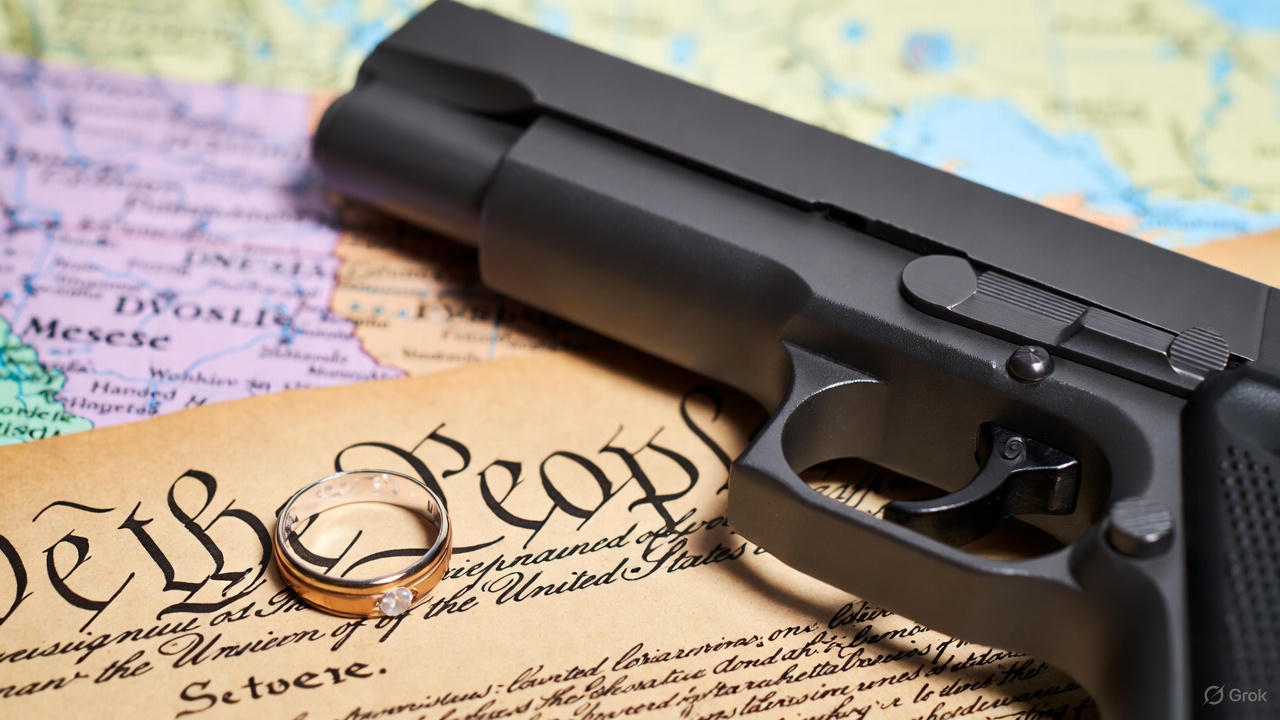
In the annals of Supreme Court history, few decisions have reshaped American liberty as profoundly as Obergefell v. Hodges in 2015. That landmark ruling, penned by Justice Anthony Kennedy, declared same-sex marriage a fundamental right under the Fourteenth Amendment, striking down state bans and mandating nationwide recognition. It ended a patchwork of laws where love recognized in one state evaporated upon crossing a border. The logic was elegant, rooted in individual autonomy, dignity, and equal protection—principles that, at their core, demand uniformity for fundamental rights.
But here’s the rub: If the Court can apply substantive due process to extend marriage equality coast to coast, why hasn’t the same scrutiny gutted the fractured landscape of Second Amendment rights? Ten years later, in 2025, concealed carry remains a state-by-state lottery—constitutional carry in 30 states, but “may-issue” permitting regimes in places like New York and California that treat your God-given right to self-defense as a privilege for the well-connected. Assault weapon bans persist in blue strongholds, red-flag laws seize arms without due process, and reciprocity? Forget it; your Tennessee permit is contraband in New Jersey.
It’s time to flip the script. Take Kennedy’s Obergefell framework and graft it onto the right to keep and bear arms. The parallels aren’t just persuasive—they’re devastating to every gun-control shibboleth still clinging to life. This isn’t about culture wars or gotchas; it’s about intellectual consistency and constitutional fidelity. Let’s break it down, principle by principle.
1. Individual Autonomy: Self-Preservation Trumps All
Kennedy wrote: “The right to personal choice regarding marriage is inherent in the concept of individual autonomy.” Marriage, he argued, is a deeply personal decision about whom we love and build our lives with—a choice that predates and outlasts any government’s permission.
Now translate that to the Second Amendment: The choice to arm oneself for self-preservation is at least as fundamental. It’s not a luxury or a hobby; it’s the bedrock of personal security in a dangerous world. As the Framers understood, life, liberty, and property mean nothing if you can’t defend them. The decision to carry a concealed firearm isn’t about “lifestyle”—it’s about survival, a core liberty interest that exists independent of the state. If the Court protects who you marry from bureaucratic meddling, it must shield how you protect your family from the same.
2. From Two-Person Union to One-Person Imperative
Obergefell celebrated marriage as a “unique intimacy” between two consenting adults, a bond so elemental that excluding same-sex couples demeaned their humanity. No state interest justified that exclusion.
Apply the lens to bearing arms: This isn’t a duo’s dance—it’s a solo act of self-reliance. Keeping and bearing arms involves one individual exercising the most primal right: defense against threats, be they criminals or tyrants. No consent from a partner (or the government) is needed; it’s inherent to human agency. If marriage’s two-person dynamic earns fundamental status, the one-person imperative of armed self-defense demands more—not less—protection. Denying it reduces citizens to wards of the state, reliant on 911 calls that arrive too late.
3. Safeguarding Children and Families: The State’s Broken Promise
Kennedy emphasized how marriage stabilizes families, especially those with children: “It would demean a married couple were it to be said marriage is simply a way to produce children.” Same-sex parents, he noted, deserve the legal scaffolding to nurture their kids.
Flip the coin for the Second Amendment: In high-crime urban corridors, rural backroads, or anywhere police response times stretch into hours, families depend on firearms for protection. Single mothers in Chicago, elderly widows in Philadelphia, immigrant families in border towns—these aren’t abstract statistics. They’re real people left defenseless by the state’s monopoly on force. When defunding police meets delayed 911 dispatches, the right to keep and bear arms isn’t optional; it’s the backstop for parental duty. Treating it as anything less abandons the vulnerable, just as denying marital rights once abandoned same-sex families.
4. The True Keystone of Social Order: An Armed Populace
Perhaps Kennedy’s most poetic line: Marriage is the “keystone of our social order,” the institution that undergirds civilization itself.
The Founders would beg to differ—and they’d have history on their side. James Madison called an armed citizenry the “advantage” of free republics over standing armies. Alexander Hamilton warned in Federalist 28 that disarming the people invites tyranny. The Second Amendment isn’t a footnote; it’s the capstone holding up the entire edifice of liberty. Without it, rights like speech, assembly, and due process become polite fictions, enforced only at the government’s whim. If marriage stabilizes society through bonds of affection, arms do so through deterrence and resolve. Dismissing the latter as “dangerous” while exalting the former is selective blindness.
5. No State Interest Justifies the Deprivation
At Obergefell‘s heart was a rebuke to half-measures: Excluding same-sex couples served “no legitimate purpose strong enough” to override their dignity. Tradition alone? Not enough. Public safety fears? Unsubstantiated.
Gun controllers, take note. “Assault weapon” bans, 10-round magazine limits, “sensitive places” carve-outs, and ex parte red-flag seizures all deprive law-abiding citizens of effective self-defense tools. Where’s the evidence that these schemes save lives without less restrictive alternatives—like targeted enforcement against actual criminals? Study after study (from the RAND Corporation to the Cato Institute) shows marginal impacts at best, often offset by black markets and compliance costs. If vague “public safety” couldn’t override marriage equality, it can’t greenlight turning free men into subjects. The burden is on the state to prove its case—not on you to beg for scraps.
6. Nationwide Uniformity: End the Border Games
Obergefell obliterated the “full faith and credit” farce: Married in Massachusetts? Valid in Mississippi. No more legal limbo at state lines.
Yet today, your concealed carry permit from Texas is a felony ticket in Illinois. Load up in Florida, and you’re a criminal in Maryland. This isn’t federalism; it’s federalism’s evil twin—arbitrary patchwork that treats constitutional rights like airline boarding passes. The Fourteenth Amendment’s Privileges or Immunities Clause, dormant since the Slaughter-House Cases but revived in whispers by McDonald v. Chicago (2010), demands better. If interstate marriage recognition is non-negotiable, so is interstate self-defense. National reciprocity isn’t a “nice-to-have”; it’s the floor of due process.
The Bottom Line: A Template Begging for Integrity
From this deadly-serious Second Amendment vantage, Obergefell‘s logic isn’t optional—it’s obligatory. Taken at face value, it doesn’t merely bolster national reciprocity or constitutional carry; it razes every material infringement save for narrow, post-conviction limits on the truly dangerous (felons, those adjudicated mentally defective). Anything broader is as indefensible as telling Jim Obergefell his vows dissolved at the Ohio River.
The Supreme Court handed us this blueprint a decade ago. Post-Bruen (2022), with its history-and-tradition mandate, the pieces are in place. All that’s lacking is five justices willing to wield substantive due process even-handedly—beyond the culture-war wins. Until then, advocates like us must press the case: in courts, legislatures, and the court of public opinion.
New Section – Update: Carolene Products Footnote Four and the Second-Class Status of the Second Amendment
Update with Mark W. Smith’s Carolene Products Framework
A 2021 scholarly article by constitutional lawyer and historian Mark W. Smith now gives the Roberts Court a second, even more powerful doctrinal hammer to finish the job that Heller, McDonald, and Bruen started.
In “Second-Class Rights and Second-Class Americans: Applying Carolene Products Footnote Four to the Second Amendment” (70 Catholic University Law Review 1 (2021), available at https://scholarship.law.edu/lawreview/vol70/iss1/9/), Smith demonstrates that the Supreme Court already possesses two long-dormant but still-binding lines of authority that obligate it to aggressively police outlier jurisdictions that treat the right to keep and bear arms as a second-class right.
The Two Carolene Products Triggers Smith Identifies:
- Heightened Scrutiny for Laws Burdening Expressly Enumerated Rights Footnote Four’s famous Paragraph Three declares that “prejudice against discrete and insular minorities” may call for “more searching judicial inquiry” – but Paragraph Two comes first and is even more on-point: legislation that restricts rights “explicitly” protected by the Bill of Rights is inherently suspect and deserves the most “exacting judicial scrutiny.” The Second Amendment is the only expressly enumerated right the modern Court still allows to be regulated under toothless rational-basis review in places like New York, California, New Jersey, and Illinois. Smith correctly calls this out as indefensible under any jurisprudential theory – originalism, living constitutionalism, or the Warren/Burger-era framework that birthed Footnote Four itself.
- National Norm Enforcement Against Outlier Local Majorities Footnote Four’s second, less-remembered prong empowers the Court to step in when a politically powerless minority is systematically oppressed by a hostile local majority. Gun owners in deep-blue cities and states are the textbook example in 2025: a discrete, insular, and intensely disfavored minority (often less than 10–15 % of the electorate in places like Manhattan, Chicago, or Los Angeles) who face total disarmament by urban political machines that openly defy Heller, McDonald, and Bruen. Meanwhile, the overwhelming majority of the country – 30 constitutional-carry states and counting – treats public carry and standard-capacity magazines as routine.
Smith’s conclusion is brutal and airtight:
“If ever there were a discrete and insular minority in need of the Court’s protection from prejudiced local majorities, it is law-abiding gun owners in the handful of jurisdictions that continue to treat the Second Amendment as a constitutional orphan.”
How Carolene Products Supercharges the Obergefell Parallel
Combine Smith’s Carolene Products framework with Kennedy’s Obergefell logic and the case for nationwide Second Amendment uniformity becomes overwhelming:
- Obergefell used substantive due process to strike down outlier marriage bans.
- Carolene Products gives the Court an alternative (and arguably stronger) equal-protection/due-process hook to strike down outlier gun bans without ever touching substantive due process – a path more palatable to originalists like Thomas and Gorsuch.
- Together they demolish the last intellectual refuge of the lower courts: the idea that the Second Amendment is some uniquely disfavored right that can be reduced to a “second-class” status in blue enclaves.
The message to the Supreme Court in 2025 is crystal clear: You already have the tools – Obergefell’s fundamental-rights uniformity mandate and Carolene Products’ national-norm enforcement power. Use them both. End the patchwork. Make the Second Amendment first-class again, everywhere, for every law-abiding American.
No more second-class rights. No more second-class citizens.
Read Mark W. Smith’s full paper here: https://scholarship.law.edu/lawreview/vol70/iss1/9/
Stay armed. Stay free.
The right to bear arms isn’t up for debate; it’s etched in the Republic’s DNA. Time to make it as unassailable nationwide as the ring on your finger.
Follow @GunsofLiberty75 for more on peaceful noncompliance and restoring 2A liberty. Views are my own, not legal advice. Happy Thanksgiving—stay armed, stay free.